CS2 Ranks and CSGO Ranks: The Complete Counter-Strike Ranking System Guide
How CS ranks work in Counter-Strike 2 and CS:GO — Premier CS Rating, competitive skill groups, what moves your rank, and how to climb faster.
Counter-Strike runs two separate ranking systems, and most of the confusion around Counter-Strike ranks comes from people mixing them up. Premier gives you a number. Competitive gives you a skill group, and gives you a different one on every map. They use the same underlying maths and they move for the same reasons, but they are not the same ladder and you can sit at very different levels on each.
This guide covers both: what the ranks are, what actually moves them, how decay works, and what the distribution looks like so you know where you really stand.
CS2 ranks vs CSGO ranks: what changed
Counter-Strike 2 replaced CS:GO in September 2023. Inventories carried over, and so did the ranking system — with two changes worth knowing.
- Competitive kept the eighteen CSGO ranks, Silver I through Global Elite. What changed is that CS2 tracks them per map. You can be Gold Nova II on Mirage and Master Guardian Elite on Ancient at the same time, and neither is "your rank" in the way CS:GO had one.
- Premier is new. Instead of a skill group it gives you a numeric CS Rating, account-wide, grouped into seven colour bands. It has a map veto before the pistol round and it is the mode the competitive scene treats as the real ladder.
If you are searching for CSGO ranks and landing here, nothing you learned is wasted. The Counter-Strike: Global Offensive ranks and the CS2 competitive ranks are the same eighteen skill groups, in the same order — only the name on the launcher and the per-map tracking changed.
CS2 Premier ranks and CS Rating
Premier ratings run from 1,000 to past 38,000, displayed as a number with a colour behind it. The colour is just a band — the number is what matters.
| Colour | CS Rating |
|---|---|
| Grey | 0 – 4,999 |
| Light blue | 5,000 – 9,999 |
| Blue | 10,000 – 14,999 |
| Purple | 15,000 – 19,999 |
| Pink | 20,000 – 24,999 |
| Red | 25,000 – 29,999 |
| Gold | 30,000+ |
To queue Premier you need Prime status and profile level 10. Competitive has no such requirement. If you have not unlocked Prime yet, our guide to Prime status covers how.
Your first rating comes after ten wins, not ten matches. Nothing is displayed until the tenth win lands, and where you start depends on how those games went.
Two things make Premier feel different from competitive once you are in:
- You see the stakes before the match. Premier shows how much rating a win is worth and how much a loss will cost before the game starts. The numbers are not fixed — they reflect the gap between the two teams.
- There is a map veto. Both teams remove maps until one is left. In practice this means you are rarely dragged onto your worst map, and a permanent ban on the map you hate is worth more rating over a season than most mechanical improvements.
Seasons reset the picture periodically and Valve adjusts the map pool with them, so a rating earned two seasons ago is not directly comparable to one earned today.
Where you actually stand
Rank distribution as of March 2026:
| CS Rating | Share of players |
|---|---|
| 1,000 – 9,999 | 39.5% |
| 10,000 – 15,000 | 34.6% |
| 16,000 – 30,000 | 25.9% |
The average sits around 10,000–11,000, which puts a typical player at the bottom of the blue band. This is worth internalising, because the community talks as though 15k is average. It is not — reaching purple already puts you well inside the top quarter.
CS2 competitive skill groups
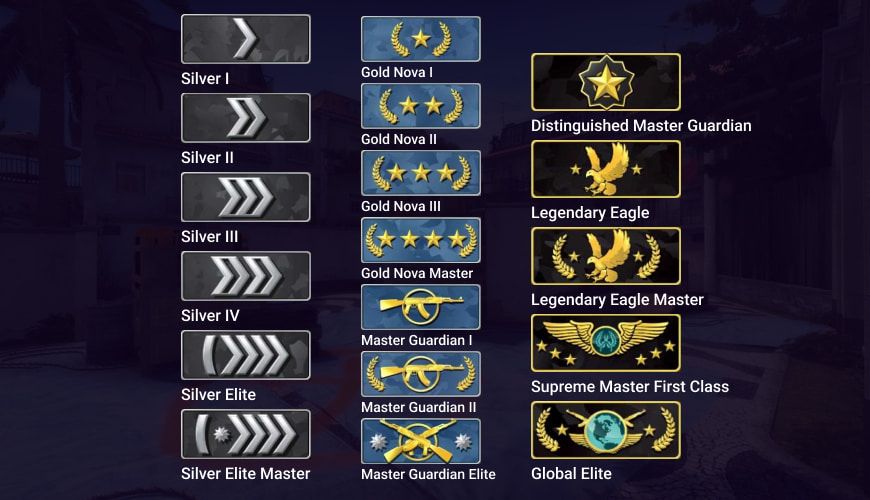
Competitive uses the eighteen skill groups inherited from CS:GO, grouped into six tiers:
| Tier | Ranks |
|---|---|
| Silver | Silver I, Silver II, Silver III, Silver IV, Silver Elite, Silver Elite Master |
| Gold Nova | Gold Nova I, Gold Nova II, Gold Nova III, Gold Nova Master |
| Master Guardian | Master Guardian I, Master Guardian II, Master Guardian Elite |
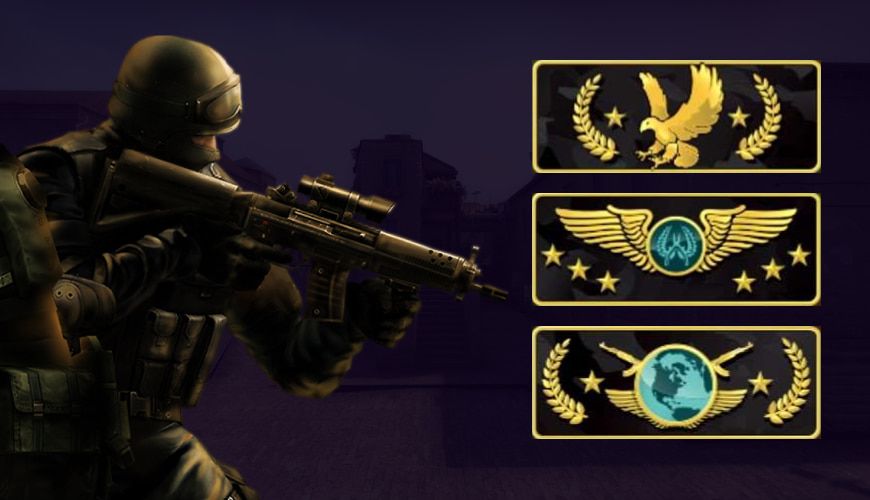
| Distinguished / Legendary | Distinguished Master Guardian, Legendary Eagle, Legendary Eagle Master |
| Supreme | Supreme Master First Class |
| Global | The Global Elite |
As with Premier, your first skill group on a map arrives after ten wins — and because ranks are per map, that is ten wins per map if you want a rank on each.
Distribution as of March 2026:
| Tier | Share of players |
|---|---|
| Silver (I – Elite Master) | 57.7% |
| Gold Nova (I – Master) | 34.4% |
| Master Guardian and above | 7.9% |
Silver I alone holds 16.1% of players, and The Global Elite is 0.2%. Competitive skews far lower than most players expect, largely because the per-map system means a lot of accounts carry a rank on a map they played ten games on two years ago and never touched again. Reaching Master Guardian I genuinely puts you above roughly nine in ten players.
What actually moves your rank
Both systems run on a modified Glicko-2 model — an Elo derivative that tracks not just your rating but how confident the system is in it. That second value is why a new account swings wildly for its first dozen games and then settles.
What feeds it:
- Match outcome. The single biggest input, in both modes. Nothing substitutes for winning.
- Opponent strength. Beating a team rated above you is worth more than beating one below. Losing to a lower-rated team costs more than losing to a higher-rated one.
- Round difference. A 13–2 win moves you further than a 13–11 win. Losses work the same way in reverse, which is why closing out a lost match respectably is not pointless.
- Individual performance. It counts, but far less than players assume. It mostly acts as a tiebreaker — it can soften a loss or sharpen a win, and it will not carry a losing record.
- Rating confidence. After a long break, or on a fresh account, the system is less sure about you and moves your number in bigger steps until it settles again.
Rank decay and inactivity
Neither system takes your rank away for not playing, but both hide it.
In Premier, your rating is hidden after roughly 14 to 28 days of inactivity, and the window is shorter the higher your rating — a gold-band player loses the display faster than a grey one. In competitive, the equivalent window is longer.
The important part is what happens underneath. Your MMR keeps drifting down while the rank is hidden, so coming back after a long absence and winning one match to reveal it typically shows you a few hundred points below where you left off. One win restores the icon; it does not restore the gap. For the full mechanics, see our guide on how long it takes for a CS rank to reset.
Common misconceptions
"Elo hell is keeping me down." Over a large enough sample your teammates are random and your opponents are random; the only constant across all your matches is you. Bad teammates absolutely cost you individual games. They do not cost you a hundred games in a row. If your rating is stable, it is because it is currently correct — that is what stable means.
"Only my K/D matters." It matters least of the inputs. Two players with identical K/D and opposite win rates end up in very different places. Fragging is a means to winning rounds, and the system scores the rounds.
"The system is rigged to keep me at 50%." Matchmaking does aim to give you even games — that is not rigging, it is the entire purpose of a rating system. A ladder that matched you against opponents you always beat would tell you nothing. Roughly 50% is what a correctly-rated player should see; the way out is to get better, which moves you to a harder 50%.
"Queueing with higher-rated friends will pull me up." It usually does the opposite. You get matched against the average of the party, so you face opponents above your level while contributing at your own. You can learn a great deal from those games. You will not gain rating from them.
How to climb
The advice that actually moves ratings is unglamorous:
- Cut your map pool. Three maps you know properly beat seven you half-know. In Premier this compounds, because the veto lets you steer toward them. In competitive it compounds harder, since ranks are per map anyway.
- Learn utility for those maps specifically. Four smokes and two flashes per map, executed reliably, is worth more rating than any amount of aim training.
- Review your own demos, not just pro streams. Watching professionals shows you what good looks like. Watching yourself shows you what you actually do — which is where the rating is.
- Warm up before ranked, not during it. Deathmatch or an aim map for ten minutes costs you nothing and stops you donating the first three rounds.
- Stop queueing when you tilt. Loss streaks are mostly one bad game followed by playing on. The single cheapest rating gain available to most players is leaving after two losses.
- Play the economy. Force-buying because you are frustrated loses more rounds than bad aim does, and round difference feeds directly into your rating.
FAQ
How do I see my CS2 rank?
Open Play, then Premier or Competitive. Premier shows your CS Rating as a number; Competitive shows a skill group per map. Neither displays until you have ten wins in that mode.
Are CSGO ranks and CS2 ranks the same?
The competitive skill groups are — the same eighteen, Silver I to Global Elite. The difference is that CS2 tracks them per map instead of per account. Premier's CS Rating has no CS:GO equivalent.
What is the average CS2 rank?
In Premier, around 10,000–11,000 CS Rating. In competitive, Gold Nova III. Both are lower than the community generally assumes.
Do I need Prime to play Premier?
Yes, plus profile level 10. Competitive is available without Prime.
How many matches do I need for my first rank?
Ten wins, in both modes. Losses do not count toward it, and nothing is shown until the tenth win.
Does my rank decay if I stop playing?
It is hidden after about 14 to 28 days in Premier, sooner at higher ratings. Your underlying MMR drifts down while hidden, so you will usually return slightly below where you left off. One win brings the display back.
Does individual performance affect my rank?
Yes, but far less than winning does. It behaves as a modifier on the match result rather than a substitute for it.
Can I rank up faster by playing with higher-ranked friends?
No. You get matched against the party's average, so you face stronger opponents without a corresponding gain. It is good practice, not a shortcut.
Why do I have different ranks on different maps?
Because CS2 competitive is per map by design. Each map holds its own skill group and its own ten-win placement.
What is Glicko-2?
The rating model Counter-Strike uses, an Elo derivative. Alongside your rating it tracks how confident the system is in that number, which is why ratings swing hard when you are new or returning and settle once you play consistently.
Artículos relacionados
CS2 Release Date: When Counter-Strike 2 Launched and What Changed
Counter-Strike 2 released on 27 September 2023, replacing CS:GO outright. The full timeline, how the Limited Test worked, and what changed at launch.
Does Mac support Counter-Strike?
Discover if Counter-Strike is compatible with Mac. Learn about gaming options on macOS and explore Counter-Strike gameplay possibilities.
How much storage does CS2 take?
Discover the storage requirements of CS2. Learn how much space you need to accommodate this popular game on your device.